Which sim racing stage suits you?
The right stage depends on how seriously you take it, how much space you have, and whether you want to race for fun or actually get faster. Here is the honest version.
Updated September 2026. The price ranges are indicative and follow the market. The current price is always shown in the configurator.
Compare all Stages
Stage 1
- You are upgrading from Logitech or Thrustmaster and want direct drive from the start
- You want a complete, calibrated package without sourcing parts separately
- You play iRacing, ACC, F1 series, Assetto Corsa or similar titles
- You have roughly 150 × 125 cm of available floor space
- You do not want to upgrade again in six months
Stage 2
- You have been sim racing for a while and want more powerful FFB
- One screen is no longer enough
- You race GT3, open-wheelers, or other high-downforce cars
- Your budget allows a step up without going to motion
Stage 3
- You already know what you want and do not want to upgrade again
- You train for real motorsport or race endurance
- Your space allows at least 3 × 3 m
- You want sim racing to feel like training, not gaming
Stage 1: for those who want to start at the right level
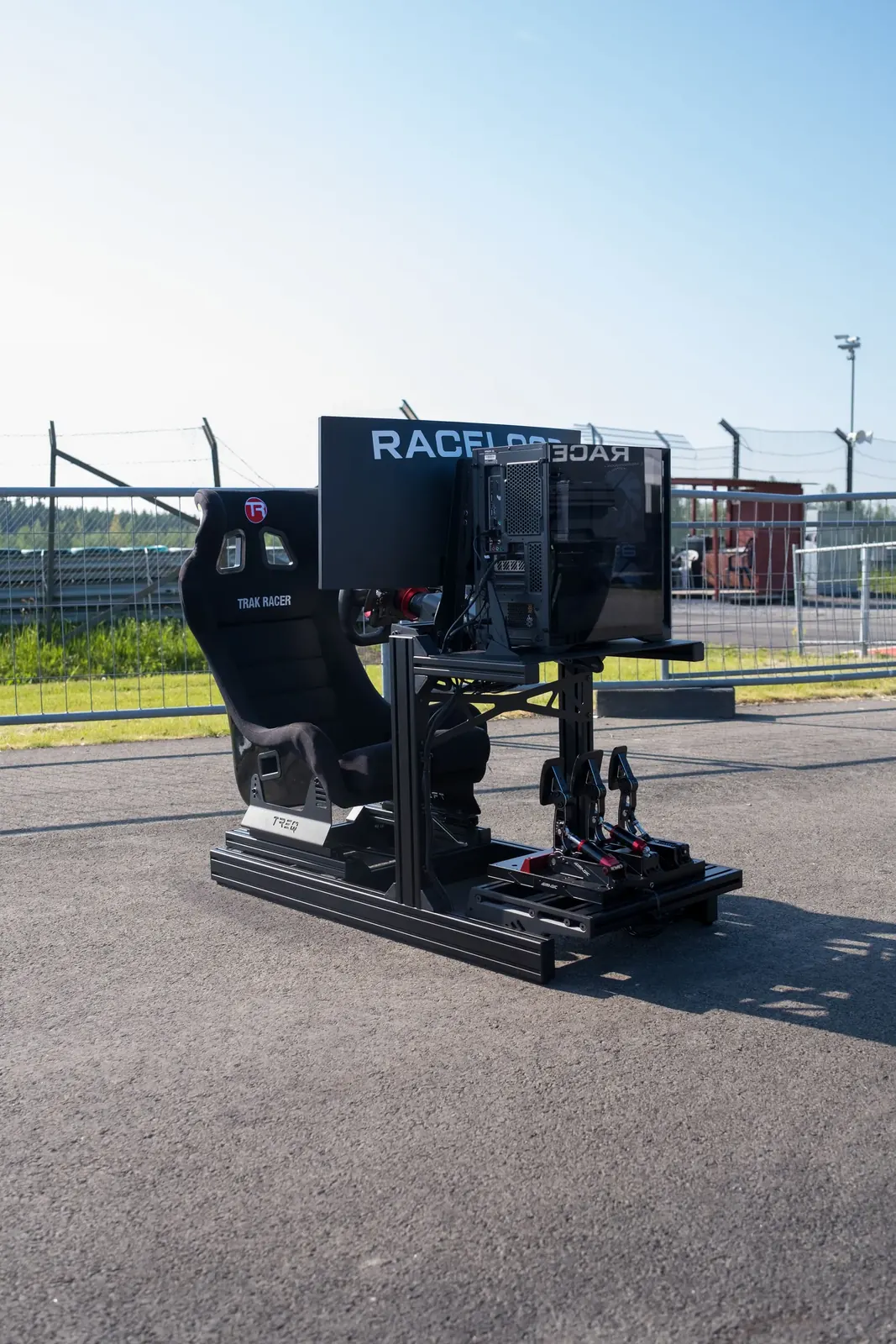
RaceLoop Stage 1 is a complete, race-ready package with a direct drive wheelbase, load-cell pedals, and a fully assembled rig. You add a PC, monitor, and stand only if you need them. what each stage costs in total.
Simagic Alpha EVO Sport 9 Nm direct drive
The Simagic Alpha EVO Sport 9 Nm direct drive is not an entry-level wheelbase with a good name. It is a third-generation direct drive motor with a 21-bit encoder and zero-cogging technology, launched in April 2025.
The 21-bit encoder registers 2,097,152 points per revolution, eight times the resolution of the previous 18-bit generation. You feel road surface, kerb strikes, and weight transfer in a level of detail belt-driven wheelbases cannot match. You are not guessing what the car is doing. You are feeling it.
Against a belt-driven system like the Thrustmaster T300 or Logitech G923: direct drive has no belt between motor and shaft, which means immediate response with no elasticity in the signal chain. The difference is noticeable from the first lap. One thing worth knowing: Simagic has built-in firmware damping that cannot be disabled. For most people this is a non-issue, but if you have been running a Simucube with zero filtering, it may take a week to readjust.
Simagic P1000 pedals
The Simagic P1000 pedals have a 100 kg load cell on the brake and Hall sensors on throttle and clutch.
A potentiometer brake measures how far you move the pedal. That builds position memory, and position memory breaks down when your seating position, temperature, or approach changes slightly. The P1000 load cell measures pressure instead. Your foot learns a force target, not a movement. Braking becomes repeatable in a way you can actually train.
RaceLoop RTX5060 16GB
The RaceLoop RTX5060 16GB is configured for sim racing, not to look impressive on a spec sheet.
The Asus GeForce RTX 5060 8 GB delivers a steady 100+ FPS in iRacing at 1440p on high settings and runs ACC comfortably on the 34" Ultrawide QLED. The PC is built for a single screen and chosen for performance per krona. If you want triple monitors, Stage 2 is the right level.
34" Ultrawide QLED
The 34" Ultrawide QLED runs 3,440 × 1,440 pixels. The wider field of view fills your natural peripheral vision better than a 27" 16:9 display, so you see more of the track through corners without turning your head. Versus triple screens: an ultrawide gives no genuine lateral depth cues, but requires no GPU compromises and takes significantly less space.
Add-ons:
- Home installation
- PC: RaceLoop RTX5060 16GB
- Display: 34" ultrawide QLED
- Monitor arm
- Peripherals: keyboard, mouse and headset
Stage 2: for those who want more feedback and a better field of view
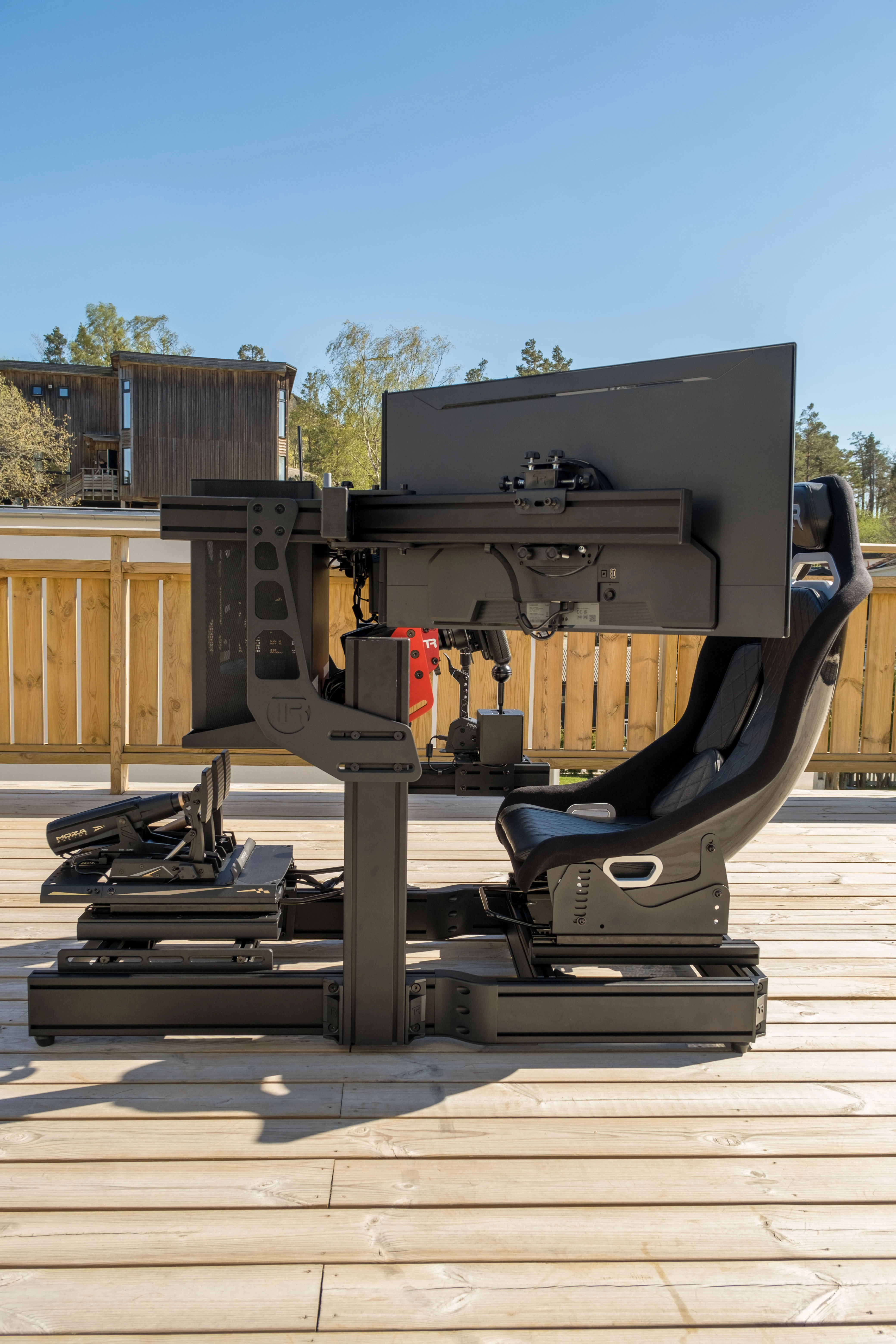
RaceLoop Stage 2 is built around the Moza R21 Ultra 21 Nm direct drive and the Moza mBooster active brake with CRP2 throttle and clutch (mounting plate included), on a 40120 aluminium profile chassis. Noticeably more physical feedback. Triple screens are an add-on.
Moza R21 Ultra 21 Nm direct drive
21 Nm is more than double Stage 1's 9 Nm and you feel the difference immediately in anything high-downforce: GT3, Formula 4, GTE.
Moza mBooster and CRP2
mBooster is the active brake pedal that simulates real brake pressure feel. CRP2 provides throttle and clutch with precise Hall sensors. Moza's mounting plate is included.
Triple screen: three 32-inch QHD monitors
Three 32-inch screens give a field of view that fills your full periphery. You see the corner coming without turning your head. The screen package is an add-on.
Add-ons:
- White Glove assembly: delivery, installation and on-site calibration
- PC: RaceLoop build, RTX 5070 class
- Monitors: three 32-inch QHD screens
- Triple monitor stand
- Speakers: 5.1 system
- Peripherals: keyboard and mouse
Stage 3: for those who want everything, with no compromise
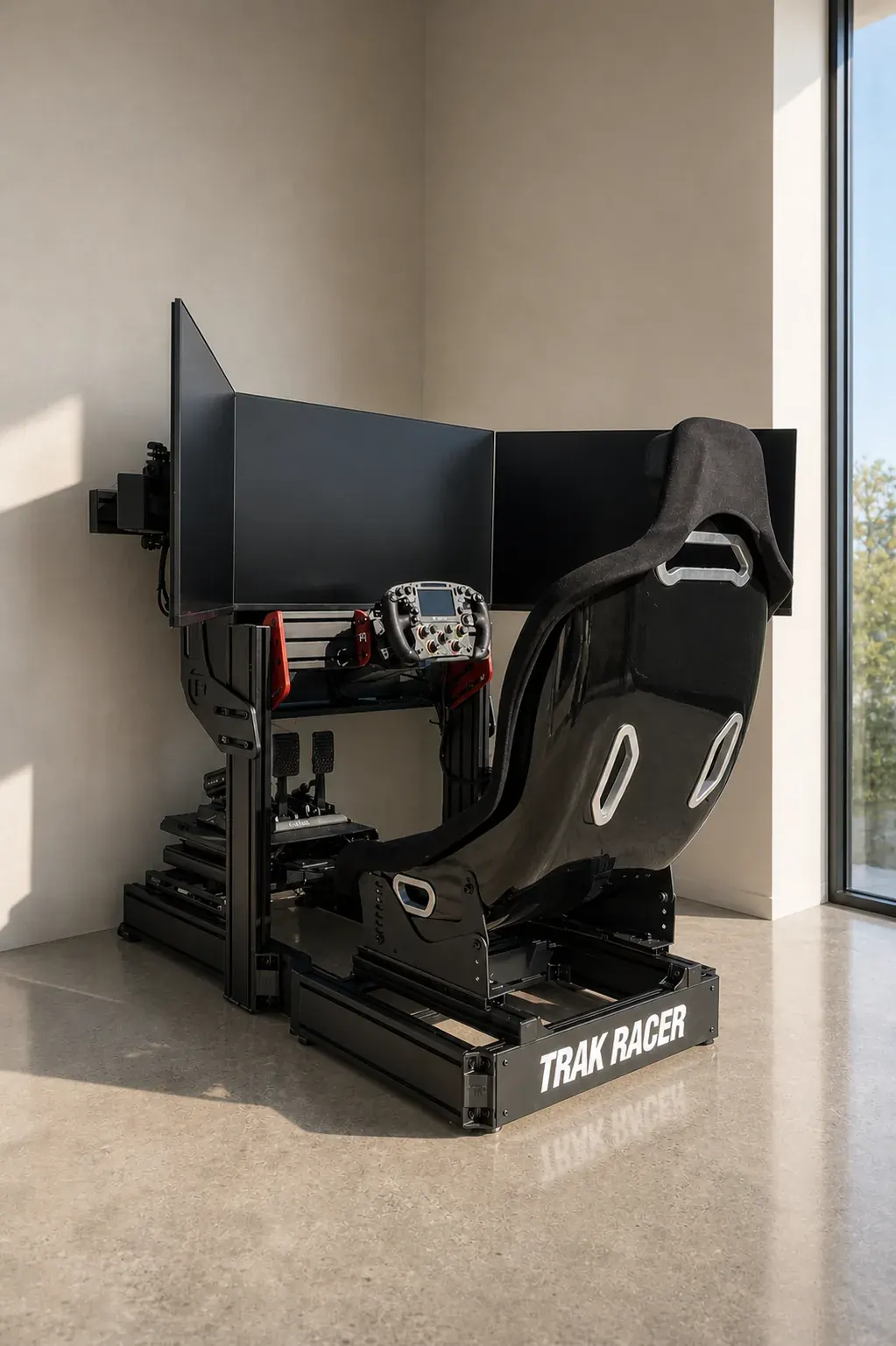
RaceLoop Stage 3 is our flagship. A Simucube 2 Pro with 25 Nm of direct drive, Simucube active pedals and a belt tensioner that tightens the harness in the braking zones. All of it on an aluminium profile chassis with a formula seating position.
Active pedals are a step beyond load cell. The brake has a motor that pushes back and vibrates, so you feel the tyre starting to lock instead of guessing. The belt tensioner pulls tight in braking zones and releases under acceleration, a signal your body reads without you thinking about it.
Stage 3 does not automatically make you faster. It removes the equipment as a limitation and makes the driving more physical. For someone training for real motorsport that difference is worth the money. For someone who primarily wants to have fun, Stage 1 or 2 is more experience per krona. A motion platform is not part of the build, but it is on its way to Stage 3.
Practical requirements: allow at least 3 × 3 m. The screens sit on a freestanding stand and need room in front of the rig. Screens and PC are add-ons, not part of the base package. Plan your space before choosing a rig.
Specifications
| Stage 1 | Stage 2 | Stage 3 | |
|---|---|---|---|
| Chassis | Treq One | 40120 aluminium profile | Sabelt P99 aluminium profile |
| Wheelbase | Simagic Alpha EVO Sport 9 Nm | Moza R21 Ultra 21 Nm | Simucube 2 Pro 25 Nm |
| Pedals | Simagic P1000 load cell | Moza mBooster active | Simucube ActivePedal Pro |
| Display (add-on) | 34" ultrawide QLED | 3× 32" QHD | 3× 34" OLED |
| Belt tensioner | - | - | Qubic QS-BT1 |
| PC (add-on) | RTX 5060 class | RTX 5070 class | RTX 5080 class |
| Price range | 35,000 to 45,000 kr | 75,000 to 90,000 kr | 115,000 to 140,000 kr |
| Space | Approx. 150 × 125 cm | Approx. 200 × 160 cm | At least 3 × 3 m |
| Home installation | Add-on | Add-on | Add-on |
Built by people who actually race
Tony and Hugo founded RaceLoop after building and racing their own rigs for over a decade. Tony studies vehicle engineering at KTH; Hugo studies business at the Stockholm School of Economics. Every stage is specified based on what produces better feedback and faster lap times, not what looks good on a spec sheet.